Three to Forty-Five. That is the present ratio of US to Russian icebreakers.1 The US, despite making an ICE deal with Canada and Finland to establish 11 more icebreakers, is still floundering behind Russia. However, the United States has not limited itself to the mere construction of steel, but to the increased technological capability to counter Russian icebreakers. Silicon trumps steel in US Arctic policy.
The US pivot to autonomous and AI-enabled systems in the Arctic is not, however, a strategy of modernization which is future-first, but rather an attempt at compensation. The United States is undeniably playing a game of catch-up with Russia in the Arctic, but autonomous systems are a method of projecting power despite a lack of it. In such a situation, it is beneficial for the United States to appear powerful and capable in the region even if it is merely a facade to disguise a lack of capability in the Arctic, while the construction of icebreakers is underway. The actual progress made in the US Arctic fleets is under fabrication; seen through the projects of Polar Security Cutters and Arctic Security Cutters, which are years behind schedule.2 This begs a question, then: to what extent do automated and AI systems substitute sovereignty enforced by a physical presence?
Vermilion on white, a stark contrast reminiscent of blood on snow, is seen throughout the coasts of Alaska, particularly best in the steel hulls which shatter their way through the walls of ice standing in their path. However, only one vessel marks this splash of red in the cold High North: the USCGC Storis.3 Its counterparts, the Healy and Polar Star, sit docked in Seattle, Washington, waiting for use. The Healy, commissioned in 1999, has seen significant use, operating as a research vessel throughout the Arctic.4 In its twenty-seventh year of service, on July 13, 2026, an engineering casualty occurred, according to the US Coast Guard (USCG), including an "engine crankcase explosion."5 The Polar Star, however, is in arguably worse shape, as it takes on its fiftieth year of service, since its commission in 1976.6 Certainly, such ships are outdated, outclassed, and as a result, prone to malfunction, as seen in the USCGC Healy. As a result, only one ship braves the thick ice and high waves of the Arctic: the Storis. Washington has not ignored its dangerous lack of icebreakers relative to Russia, with the Polar Security Cutter program initiating in a 2019 contract with an original delivery target of 2024. However, the current GAO estimation is 2033, with overrun costs of roughly $3.4 billion for the lead ship alone.7 As a result, the USCG is unable to maintain a physical presence in the white and navy landscape of the High North. Such a weak point must be shielded with short-term patches, while the long-term solutions are slowly established. The result is a more autonomous Coast Guard in the Arctic.
Internationally, the rewards of militarization have been made clear. Russia shifted from an economic policy to a deliberately militant one following 2022, corresponding with Russia's initial invasion of Ukraine. The result was an expanded Northern Fleet, Yasen-M submarines, and bases in the Kola Peninsula.8 This is compounded by the forty-five-ship icebreaker fleet Russia has established, including specifically combat-designed icebreakers, such as the Ivan Papanin,9 and Sergei Lavrov's aggressive posture towards Russia's international role.10 China, in tandem, has claimed its role as a "near-Arctic state," and as such has expanded its Xue Long fleet with nuclear icebreaker prototypes, as well as a record number of vessels in and around US Arctic waters and airspace in 2025, according to DHS.11 12 Such a development of these international roles is, as previously stated, in tandem, because Russia and China have worked together deliberately to expand their Arctic footprint, conducting joint operations, allowing Chinese ships and planes to travel farther north than ever before.13 What is more significant than a Russian northern neighbor with fifteen times the icebreakers, or a Chinese expansion of naval capability, is the combination of both powers seeking to lay claim to a region which remains highly contested. As the world has become more intertwined, it is less palatable for a nation to invade another nation directly; instead, it is the unclaimed spaces and territories, such as those China has experienced, particularly surrounding the Philippine Batanes and regions of the South China Sea,14 as does Russia, as seen in Crimea.15 Such contested, unclear spaces, particularly the mineral-rich Arctic, provide the perfect battleground for Russia and China to amass power without risking international legitimacy. There is minimal loss of life; it is out of sight and out of mind for much of the world, the United States lacks a strong presence, and expansion is seen not as an act of provocation or invasion, but simply exploration. Nonetheless, nations do not patrol waters they do not intend to stake some claim to, sooner or later. As a result of this international pressure, the pivot from shipbuilding to technology-supplementing in the USCG's Arctic policy should come as no surprise. Such a shift towards autonomy provides more presence in the Arctic than the US would otherwise have, at such a critical time.
The USCG's use of autonomy as a structural strategy, rather than merely an addition to an existing structure, is reflected in its organization. The establishment of the Robotics and Autonomous Systems Program Executive Office (RAS PEO) in 2025 marked the first clear indication of the USCG taking technological policy by the helm in the Arctic.16 The RAS PEO was framed deliberately as a core piece of Force Design 2028 and described as "poised to be the most transformational enhancement to capability . . . since the inception of aviation."17 This is not merely a different distribution of funds so much as a fundamental shift in USCG policy, strategy, and organization. Unmanned systems have, prior to RAS PEO, remained scattered across multiple offices without centralization, and served as isolated pet projects.18 This newly developed structure the USCG has implemented instead organizes the portfolio by domain-specifically land, air, space, and shoreline. Such a design mirrors the Navy in its own unmanned programs; such is the path the USCG has taken. It is not simply increasing its stock of robotics technology or drones, but rather has reoriented specifically around a system the Navy utilizes for scaling autonomous programs.
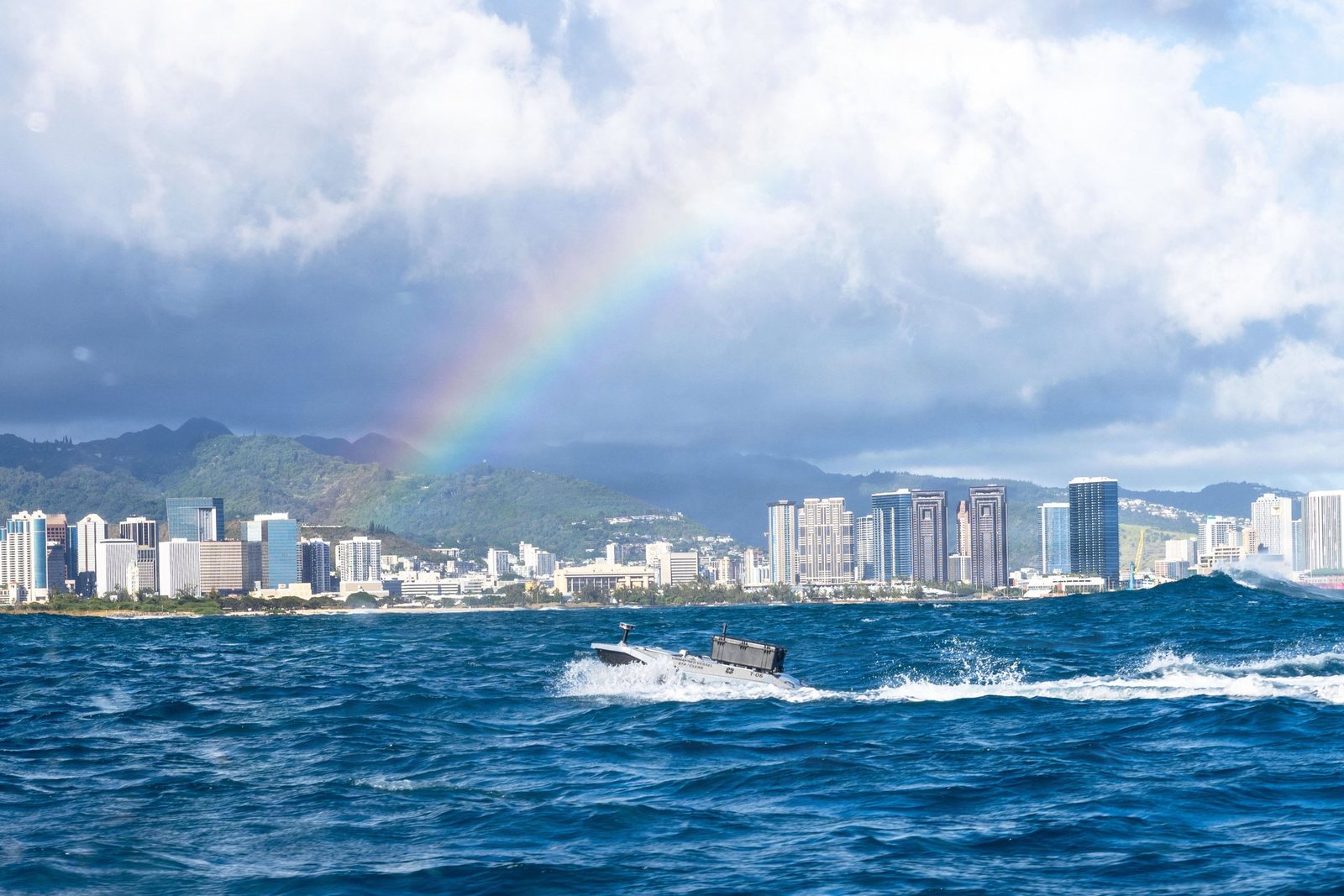
The RAS PEO leadership has avoided traditional Federal Acquisition Regulation (FAR) based procurement in favor of commercial solutions openings, and other transaction authorities as a means of accelerating fielding.19 This high-speed acquisition is a direct response to the pressure exerted from Russia and China upon the USCG. The USCG is deliberately selecting a technology which is faster to acquire and implement, less traditional in US government contracting; this reflects the fact that the USCG cannot afford to wait for ships to be built. Instead, it establishes a faster pipeline of technology and equipment: equipment like Saildrone-type USVs,20 under-ice AUVs such as the Tethys-class,21 as well as small-satellite constellations like the Polar Scout-type CubeSats.22 This hardware is in part run through AI-processed synthetic aperture radar (SAR) imagery; however, it is imperative to note that the US is rapidly closing the gap with Russia in terms of awareness in the Arctic- these tools serve as the eyes of the USCG in the seas, shore, and surface. The lack of physical combatants and icebreakers, however, does indicate an absence in the region. Awareness is greatly beneficial, and autonomy is a multiplier of this awareness, but it is not a substitute for the platforms and materiel which interdict, escort, engage, and coerce the way a proper fleet is able.
These autonomous systems, however, are not fully operated by the USCG; they are bought as well as rented by the USCG. Contractors fly and maintain the systems while the government pays for the hours or effect delivered, technology launched from cutters and shore sites, as opposed to the USCG deploying this technology on its own, without paying contractors.23 The sluggish aspect of much technological adaptation is the process of learning, utilizing, and training; the USCG avoids this step entirely by paying these contractors, immediate power and action, no training necessary. However, a contractor-dependent ISR posture in a contested Arctic environment raises continuity-of-operations concerns should a contractor be unable or unwilling to operate in a crisis or dangerous situation. These contractors are not private military companies, but rather drone operators; as such, their roles do not include specifically acting in crisis or conflict; it is such situations, however, in which their skills would be particularly required. That is not to say the USCG lacks the manpower and training to adapt this technology without contractors, merely that it is in the early stages of development. The USCG has confirmed it is developing a Robotics Mission rating as one of the RAS PEO's lines of effort, clearly demarcating a shift in structure as opposed to just the technology utilized.24 One of the slowest-moving personnel structures in any armed service has gained a new pathway, one which indicates that autonomy serves as a permanent operational specialty, not an auxiliary skill. Specialization of labor, therefore, has been embedded in a system as sluggish as rank.
The RAS PEO serves as one of the most efficient responses in the US military system; the project began as a concept and quickly came to life in mere months, achieving Initial Operating Capability. Furthermore, it is designed specifically to grow and adapt to advancing and evolving software cycles. Icebreaker programs, as seen above, are long endeavors, taking years between contracting and steel-cutting, then further years to officially commission.25 The arduous path to shipbuilding an icebreaker is time- and cost-consuming on a great scale, whereas the implementation of a semi-permanent contractor force with technology and training already in the works is a swift course to cut. That said, it is not an accelerated system because it is of greater strategic importance than a physical presence; rather, because it is fast, it has been prioritized. A quick fix is what the USCG required, and received; the long-term issue of physical power in the Arctic remains, with the icebreakers in the shop.
The shop itself does provide relief to the pressure mounting from China and Russia in the Arctic. The Arctic Security Cutter (ASC) program indicates that the USCG does not simply believe sensors and software will solve the issue of presence- or lack thereof- in the Arctic. A simultaneous push for steel and silicon provides the USCG a pathway, as the USCG attempts to force through the fastest hull-recapitalization effort in the service's modern history, directly distinct and deliberately faster than the Polar Security Cutter (PSC) program, which faced significant delays. The ASC program totals eleven ships, built through a trilateral agreement under the 2024 ICE Pact between the United States, Canada, and Finland.26 To accelerate the shipbuilding process, contracts have been issued to multiple yards, namely Rauma Marine Constructions in Finland and Bollinger Shipyards in Louisiana,27 and the Davie Defense/Helsinki Shipyard, which constructs both in Finland and in the United States, under a $3.5 billion contract running through February 2035, covering the Davie-built portion alone.28 Steel was first cut for the cutters in Finland in mid-2026 for the initial hull, with the fastest delivery expected in 2028 for the Finnish-built ships and 2029 for the US-built vessels at Bollinger's Louisiana yard.29
The role of Finland participating in an icebreaker pact also establishes a future precedent: that the US will not serve alone on the international stage in protecting freedom of navigation, trade, and the security of the globalized economy.30 Such a role of international participation in naval and oceanic endeavors is novel and imperative for US policy; the world following the rise of the US-led order in 1945 did not participate significantly in the security of its own order-instead, that burden fell upon the United States. However, as a new frontier quite literally breaks open, international northern powers are participating with the United States to defend against threats such as Russia and China. Although playing catch-up, the nations working in conjunction are able to craft significant gains through the leveraging of teamwork, which was previously absent, particularly in US icebreaker endeavors. The industrial base is leveraging overseas capability and proven shipbuilding in Finland to onshore more work into the United States and rebuild the defense industrial base, while also supporting allies- and being supported by them. The ominous perspective of this is difficult to disguise, however: the United States depends upon an allied nation for security and a defense industrial complex, in a volatile region. Nonetheless, even while leveraging allies, the project still sits years away.
Ultimately, such coordination between the United States, Canada, and Finland is imperative for long-term Arctic security, while the USCG utilizes short-term solutions in a structural way. The USCG's usage of autonomy is not simply a short-term solution, although it is; it is also a structural change designed to allow future accommodation of software with hardware- regardless of how long the hardware takes. What must be analyzed, then, given these compounding factors of software and hardware, is the viability of the solution the USCG has selected. In short, has silicon, even temporarily, substituted steel?
Historically, the Arctic has never been secured by surveillance or remote sensing; instead, physical presence of ships in the ice has proven such a stance. Given the role of Chinese ships and planes reaching farther north than ever before documented, the inability of the United States to respond, merely to surveil, is significant. The United States may be able to observe these trends remotely, but fundamentally it cannot do anything to prevent them. As Russia's nuclear-powered icebreakers take to the seas, contracted drones accomplish little in the short term, even if in the long term they may provide critical intelligence; they merely watch as the Russian vessels barrel forth. Arctic cutters utilizing AEGIS and potential kill-web architecture provide a unique solution; nonetheless, questions must be asked of the USCG's role.31 It appears the USCG is serving as a sensory nerve for the Department of Defense, rather than a strike force, and the mission creep of Arctic activity utilizing robotics remains untested. In the end, a maritime domain awareness (MDA) system that perceives Russian and Chinese vessels may improve awareness but does not provide deterrence. A shield of cameras is no shield at all. That said, a future in which intelligence and hardware are used in tandem provides the greatest leverage the USCG could hold in the Arctic. Intelligent warfare changes the game significantly; sensing the enemy first provides early warning, strategic response, offensive options, and unique power to the USCG. Knowledge, in short, is power; software provides the knowledge, but the icebreakers and hardware required are still unready, and so the power cannot find a proper channel at this time.
This article argues that such developments are not in vain, however, and although they may be designed as band-aids on bullet holes, they serve a larger purpose. Innovation and the utilization of novel technologies in a testing ground such as the Arctic serve two goals. First, it provides a substitute for presence, regardless of how effective, relative to a pure absence as a whole. Second, it provides a proving ground for technological change, incorporation, and cost. Such an argument would be quite different if the USCG instead utilized old ships, such as the USCGC Polar Star, in the Arctic, and simply made do without innovation. Instead, the USCG deliberately contributed material to establish a stronger technological base in the Arctic, even if the hardware that will utilize it is still in the works. The long-term solution of a fleet of icebreakers is, of course, critical, but such a fleet requires tried-and-true technology to supplement it; such technology, made to endure the cold and pierce through ice with radar as well as steel hulls, is a step in the right direction, even if it is not the leap that is required.
The Arctic region may not yet be an international hot spot. No shots are fired, merely patrols and practice operations. Nonetheless, it was such training exercises that preceded the Russian invasion of Ukraine;32 it is such exercises China practices directly around Taiwan.33 The playbook remains the same: China's history of harassing fishermen in international waters is even present in the Arctic, as the northernmost operation conducted by China- in tandem with Russia- was explained away as a fisheries enforcement patrol, not a military drill of expanding capability.34 The Arctic, therefore, is not the most obvious region of the world for geopolitics to play out; the Middle East, by contrast, is significantly hotter, particularly with the US-Iran conflict.35 However, it is this very concealment which provides Russia and China room for expansion and conquest in an unclaimed, resource-rich region. The world likely has many years until conflict over the Arctic breaks out. Nonetheless, such a day will come, as the ice slowly cracks not under the force of icebreakers but under the heat of the sun and Earth. The more accessible the Arctic becomes, the more critical it is; it serves as one of the final frontiers of conquest, and perhaps one of the most valuable pieces of Earth. The USCG's actions to expand into the Arctic by 2033 are ambitious, and rightfully so; however, they may be too little, too late, even with an additional eleven icebreakers, the United States would only have a fourteen-to-forty-five ratio against Russia alone.36 The implications of China's expansion only worsen such odds.
Technology, therefore, is the saving grace where mere power falls short. It is superior to have one tank than a hundred horses. Should the USCG's innovations, meant to buy time in the Arctic, improve during their duration therein, such an advantage could greatly aid the United States in the region and, through a policy of deterrence, help prevent the expansion of too many powers in the ocean. Peace through deterrence is a viable strategy; nonetheless, it is imperative to prepare a strategy for the case in which the United States lacks the same capabilities as Russia or China in the Arctic, and to understand what that means for US power and policy.
AI and autonomous technology in the Arctic bridges a strategy that resulted from dysfunction in acquisition, and does not serve solely as a leap forward. It is the covering of a lack of quantity, materiel, and firepower with technology. US influence in the Arctic is not stagnant, however, and should the ASC and PSC deliveries fall further behind schedule, the risk could be high; likewise, if the technology is not truly beneficial, and MDA data does not feed into real interagency capability, the risk is higher still. Lastly, the variables of Russia and China, their cooperation or potential competition in the Arctic, only increase competition in the region and exacerbate concerns for US northern security. Substitution is not a strategy; however, technology is crucial if implemented in accordance with a timeline. Software is powerful, but it requires hardware; the USCG strives to utilize both, and a successful pairing of the two will greatly strengthen the USCG after a period of trailing Russia in the High North. If the Arctic is to remain free of blood on ice and snow, the presence of vermilion USCGC ships such as the Storis is imperative; the role of the technology now aboard remains to be seen.
The fundamental question, therefore, is one of time. If the Arctic remains physically uncontested by the time the USCG retains a physical presence with a fleet of icebreakers, enabled by the new technology, then the United States retains security in the region. If instead the ice melts faster, Russia becomes more ambitious, China more aggressive, or vital resources are strained, forcing extraction from the region before the USCG is able to act, the United States is at high risk in the High North.
1. Steve Kopack, "How Chinese, Russian Arctic Ambitions Are Fueling a U.S. Polar Icebreaker Mission," CNBC, updated 2026, https://www.cnbc.com/how-chinese-russian-arctic-ambitions-are-fueling-a-us-polar-icebreaker-mission.html. "360° View of America's 'ICE Pact' Polar Icebreaker Partnership with Canada and Finland," Wilson Center, 2025, https://www.wilsoncenter.org/article/360-view-americas-ice-pact-polar-icebreaker-partnership-canada-and-finland. "Beyond Icebreakers: The United States Needs a Bold New Approach to Arctic Security," Modern War Institute at West Point, https://mwi.westpoint.edu/beyond-icebreakers-the-united-states-needs-a-bold-new-approach-to-arctic-security/. "ICE Pact: Why the US Had to Recruit Help in Race with Russia, China for Arctic Icebreakers," Breaking Defense, https://breakingdefense.com/ice-pact-why-the-us-had-to-recruit-help-in-race-with-russia-china-for-arctic-icebreakers/. "China and Russia and the US Icebreaker Race," Responsible Statecraft, https://responsiblestatecraft.org/china-and-russia-and-the-us-icebreaker-race/. ↩
2. John Konrad, "U.S. Polar Security Cutter Delayed to 2033 as Costs Top $6 Billion, GAO Warns," gCaptain, 2026, https://gcaptain.com/u-s-polar-security-cutter-delayed-to-2033-as-costs-top-6-billion-gao-warns/. Congressional Budget Office, "The Cost of the Coast Guard's Polar Security Cutter," 2024, https://www.cbo.gov/publication/60408. "GAO Weighs In on Polar Security Cutter Delays," HSToday, 2026, https://www.hstoday.us/subject-matter-areas/maritime-security/gao-weighs-in-on-polar-security-cutter-delays/. ↩
3. "Coast Guard Commissions First New Icebreaker Since the 1990s," USNI News, 2025, https://news.usni.org/2025/coast-guard-commissions-first-new-icebreaker-since-the-1990s. "Coast Guard's Newest Icebreaker Returns from Bering Sea Deployment," The National Interest, 2026, https://nationalinterest.org/blog/coast-guards-newest-icebreaker-returns-from-bering-sea-deployment. ↩
4. Wikipedia, s.v. "USCGC Healy," accessed August 2026, https://en.wikipedia.org/wiki/USCGC_Healy. ↩
5. Malte Humpert, "Exclusive: USCG Icebreaker 'Healy' Towed Back to Seattle Following 'Significant Engineering Casualty,'" gCaptain, July 24, 2026, https://gcaptain.com/exclusive-uscg-icebreaker-healy-towed-back-to-seattle-following-significant-engineering-casualty/. "Coast Guard Reports Icebreaker Breakdown near Seattle," Stars and Stripes, July 24, 2026, https://www.stripes.com/branches/coast_guard/2026-07-24/uscgc-healy-sidelined-engineering-casualty-22357038.html. ↩
6. Wikipedia, s.v. "USCGC Polar Star (WAGB-10)," accessed August 2026, https://en.wikipedia.org/wiki/USCGC_Polar_Star_(WAGB-10). "Coast Guard Commissions First New Icebreaker Since the 1990s," USNI News, 2025. ↩
7. John Konrad, "U.S. Polar Security Cutter Delayed to 2033 as Costs Top $6 Billion, GAO Warns," gCaptain, 2026. Congressional Budget Office, "The Cost of the Coast Guard's Polar Security Cutter," 2024. "Congressional Report Details New Delays and Cost Overruns for Coast Guard Icebreaker," gCaptain, 2026, https://gcaptain.com/congressional-report-details-new-delays-and-cost-overruns-for-coast-guard-icebreaker/. "U.S. Polar Icebreaker Faces New Delays and Cost Overruns, Report Says," High North News, https://www.highnorthnews.com/en/us-polar-icebreaker-faces-new-delays-and-cost-overruns-report-says. ↩
8. "Russia Is Expanding Its Arctic Submarine Fleet, Highlighting NATO's Need for Enhanced Maritime Surveillance in the High North," Foundation for Defense of Democracies, August 4, 2026, https://www.fdd.org/analysis/2026/08/04/russia-is-expanding-its-arctic-submarine-fleet-highlighting-natos-need-for-enha nced-maritime-surveillance-in-the-high-north/. "The Ice Curtain: Modernization on the Kola Peninsula," Center for Strategic and International Studies, https://www.csis.org/analysis/ice-curtain-modernization-kola-peninsula. "The Militarization of Russian Polar Politics," Chatham House, https://www.chathamhouse.org/the-european-arctic-the-kola-bastion-and-the-high-north. "Arctic Spillover? Military Signalling in the European Arctic before and after the Full-Scale Invasion of Ukraine," Scandinavian Journal of Military Studies, https://sjms.nu/articles/arctic-spillover-military-signalling. ↩
9. "Russia's New 'Combat Icebreaker' Undergoes Ice Trials Ahead of Joining Northern Fleet," gCaptain, April 22, 2025, https://gcaptain.com/russias-new-combat-icebreaker-undergoes-ice-trials-ahead-of-joining-northern-fleet/. "The Russian Navy's New Combat Icebreaker: Ivan Papanin," The National Interest, October 27, 2025, https://nationalinterest.org/blog/buzz/the-russian-navys-new-combat-icebreaker-ivan-papanin. Steve Kopack, "How Chinese, Russian Arctic Ambitions Are Fueling a U.S. Polar Icebreaker Mission," CNBC, 2026. "Russian's New Combat Icebreaker Starts Sea Trials," The War Zone, https://www.twz.com/news-features/russians-new-combat-icebreaker-starts-sea-trials. "Russia's Armed Icebreaker Ivan Papanin Completes Arctic Trials," ArcticToday, https://www.arctictoday.com/russias-armed-icebreaker-ivan-papanin-completes-arctic-trials/. ↩
10. Sergey Lavrov, "Greeting to the Organisers and Participants of the 2nd Forum 'The Arctic – Our Common Home,'" Ministry of Foreign Affairs of the Russian Federation, republished via GlobalSecurity.org, 2026, https://www.globalsecurity.org/military/library/news/2026/foreign-minister-sergey-lavrov-arctic-forum.htm. ↩
11. "China and the Arctic: An Overview," Observer Research Foundation, https://www.orfonline.org/expert-speak/china-and-the-arctic-an-overview. "Checking Back in on China's Nuclear Icebreaker," The Diplomat, https://thediplomat.com/checking-back-in-on-chinas-nuclear-icebreaker/. "Why Is the US Uneasy as China's Five-Strong Icebreaker Fleet Arrives in the Arctic?," South China Morning Post, https://www.scmp.com/news/china/diplomacy/article/why-is-the-us-uneasy-as-chinas-5-strong-icebreaker-fleet-arrives-i n-the-arctic. "Icebreakers of Influence: NATO and the Dual-Use China-Russia Arctic Threat," Bloomsbury Intelligence and Security Institute, https://bisi.org.uk/reports/icebreakers-of-influence-nato-and-the-dual-use-china-russia-arctic-threat. "NATO Ally Shadows China Icebreaker," Newsweek, https://www.newsweek.com/nato-ally-shadows-china-icebreaker.
12. "DHS Warns of 'Unprecedented' Chinese Presence in Arctic during Summer 2025," gCaptain, 2025, https://gcaptain.com/dhs-warns-of-unprecedented-chinese-presence-in-arctic-during-summer-2025/. "China Has 'Unprecedented Number' of Ships in U.S. Arctic Waters, DHS Says," CBS News, 2025, https://www.cbsnews.com/news/china-unprecedented-number-ships-us-arctic-waters-dhs/. "Chinese Research Vessels Enter U.S. Extended Continental Shelf in Arctic, Coast Guard Monitors with Icebreaker 'Healy,'" High North News, https://www.highnorthnews.com/en/chinese-research-vessels-enter-us-extended-continental-shelf-arctic-coast-guard-mon itors-icebreaker. "Coast Guard 'Naming and Shaming' amid Spike in Chinese Activity near Alaska," Breaking Defense, https://breakingdefense.com/coast-guard-naming-and-shaming-amid-spike-in-chinese-activity-near-alaska/.
13. "Sino-Russian Cooperation in the Arctic," Center for European Policy Analysis, https://cepa.org/analysis/sino-russian-cooperation-in-the-arctic/. "Chinese, Russian Coast Guards Conduct Joint Patrols in Arctic Ocean, Marking CCG's First Entry into the Region," Global Times, October 2, 2024, republished via GlobalSecurity.org, https://www.globalsecurity.org/wmd/library/news/china/2024/10/china-241002-globaltimes01.htm. "China, Russia Increase Arctic Cooperation, but Distrust Presents Roadblocks, Report Says," National Defense Magazine, https://www.nationaldefensemagazine.org/articles/china-russia-arctic-cooperation-distrust-report. "First Joint Russian–PRC Submarine Exercise Patrols Pacific," Jamestown Foundation, https://jamestown.org/program/first-joint-russian-prc-submarine-exercise-patrols-pacific/. "China-Russia Coast Guard Cooperation: A New Dimension of China-Russia Relations?," ChinaPower Project, Center for Strategic and International Studies, https://chinapower.csis.org/china-russia-coast-guard-cooperation/. "China-Russia Arctic Cooperation a US National Security Concern," Voice of America, https://www.voanews.com/a/china-russia-arctic-cooperation-a-us-national-security-concern/. ↩
14. "Persistent Gray Zone Aggression in the South China Sea Calls for Increased Coordination in Rule of Law," RAND Corporation, https://www.rand.org/pubs/commentary/persistent-gray-zone-aggression-south-china-sea.html. "What Taiwan Can Learn from China's Gray-Zone Actions against the Philippines," Atlantic Council, October 2025, https://www.atlanticcouncil.org/in-depth-research-reports/report/what-taiwan-can-learn-from-chinas-gray-zone-actions-a gainst-the-philippines/. "China's Grey-Zone Tactics Are Reshaping the South China Sea," Modern Diplomacy, https://moderndiplomacy.eu/chinas-grey-zone-tactics-are-reshaping-the-south-china-sea/. "Deterring China's Salami Tactics," Center for Maritime Strategy, https://centerformaritimestrategy.org/deterring-chinas-salami-tactics/. ↩
15. "High North, High Tension: The End of Arctic Illusions," Foreign Policy Research Institute, https://www.fpri.org/article/high-north-high-tension-the-end-of-arctic-illusions/. ↩
16. "Coast Guard Establishes New Program Executive Office Dedicated to Robotics and Autonomous Systems," U.S. Coast Guard press release, August 19, 2025, republished via GlobalSecurity.org, https://www.globalsecurity.org/military/library/news/2025/08/mil-250819-uscg01.htm. "Coast Guard Establishes New PEO Dedicated to Robotics and Autonomous Systems," Seapower, August 21, 2025, https://seapowermagazine.org/coast-guard-establishes-new-program-executive-office-dedicated-to-robotics-and-autonom ous-systems/. ↩
17. "Coast Guard Establishes New Program Executive Office Dedicated to Robotics and Autonomous Systems," U.S. Coast Guard press release, 2025. "New U.S. Coast Guard PEO Launches Internship Program," AFCEA Signal, September 5, 2025, https://www.afcea.org/signal-media/new-us-coast-guard-peo-launches-internship-program. ↩
18. "Robotics, Autonomy Transforming Coast Guard Ops," National Defense Magazine, https://www.nationaldefensemagazine.org/articles/robotics-autonomy-transforming-coast-guard-ops. "Coast Guard Launches RAS PEO to Unify Uncrewed Systems," GovCIO Media & Research, https://govciomedia.com/coast-guard-launches-ras-peo-to-unify-uncrewed-systems/. ↩
19. "Unlocking New Contracting Opportunities with the U.S. Coast Guard," PilieroMazza, https://www.pilieromazza.com/unlocking-new-contracting-opportunities-with-the-u-s-coast-guard/. "An Offeror's Legal Guide to Commercial Solutions Openings," Holland & Knight, https://www.hklaw.com/en/insights/publications/an-offerors-legal-guide-to-commercial-solutions-openings. ↩
20. "Coast Guard Wants Contractors to Provide and Operate Drone Services from Cutters, Shore-Based Sites," DefenseScoop, https://defensescoop.com/coast-guard-contractor-operated-drone-services/. "US Coast Guard Expands Maritime Surveillance with Saildrone Voyager Fleet," The Defense Post, https://thedefensepost.com/us-coast-guard-expands-maritime-surveillance-saildrone-voyager-fleet/. "US Coast Guard to Test Autonomous MDA Capabilities," Saildrone, https://www.saildrone.com/news/us-coast-guard-to-test-autonomous-mda-capabilities. "Saildrone Deploys 16 Voyager USVs for Coast Guard Great Lakes Mission," DroneLife, https://dronelife.com/saildrone-deploys-16-voyager-usvs-for-coast-guard-great-lakes-mission/. ↩
21. "Tethys-Class Long-Range Autonomous Underwater Vehicle (LRAUV), USA," Naval Technology, https://www.naval-technology.com/projects/tethys-class-long-range-autonomous-underwater-vehicle-lrauv-usa/. Brian Kieft et al., "Hydrodynamic Testing of the Tethys Long-Range Autonomous Underwater Vehicle," in Proceedings of the IEEE/OES Autonomous Underwater Vehicles Conference (2012), Monterey Bay Aquarium Research Institute, https://www.mbari.org/wp-content/uploads/2016/01/Hobson_etal_AUV2012.pdf. ↩
22. "A Shoebox-Sized Solution: How Small Satellites Can Help the US Coast Guard," Atlantic Council, https://www.atlanticcouncil.org/a-shoebox-sized-solution-how-small-satellites-can-help-the-us-coast-guard/. "Coast Guard's Polar Scout Satellites Aid in Arctic Rescue," The Aerospace Corporation, https://aerospace.org/article/coast-guards-polar-scout-satellites-aid-arctic-rescue. "Coast Guard's Polar Scout CubeSats Aid in Arctic Rescues," Parabolic Arc, https://www.parabolicarc.com/coast-guards-polar-scout-cubesats-aid-in-arctic-rescues/. "Polar Scout," eoPortal, https://www.eoportal.org/satellite-missions/polar-scout. ↩
23. "Coast Guard Wants Contractors to Provide and Operate Drone Services from Cutters, Shore-Based Sites," DefenseScoop. "Coast Guard Issues RFI for Contractor-Operated Drone ISR Support," ExecutiveGov, https://executivegov.com/coast-guard-issues-rfi-for-contractor-operated-drone-isr-support/. ↩
24. Heather Mongilio, "Coast Guard Wings MQ-9 Drone Pilot, Expands Unmanned Careers," USNI News, August 26, 2025, https://news.usni.org/2025/08/26/coast-guard-wings-mq-9-drone-pilot-expands-unmanned-careers. ↩
25. "Beyond Icebreakers: The United States Needs a Bold New Approach to Arctic Security," Modern War Institute at West Point, https://mwi.westpoint.edu/beyond-icebreakers-the-united-states-needs-a-bold-new-approach-to-arctic-security/. ↩
26. Wikipedia, s.v. "Arctic Security Cutter Program," accessed August 2026, https://en.wikipedia.org/wiki/Arctic_Security_Cutter_program. "360° View of America's 'ICE Pact' Polar Icebreaker Partnership with Canada and Finland," Wilson Center, 2025. "Arctic Security Cutters (ASCs)," Made in America, U.S. General Services Administration, https://www.madeinamerica.gov/waivers/nonavailability/69470a05dad97124a5220c4b. ↩
27. "U.S. Awards Contracts for Six Arctic Cutters to Rauma Marine and Bollinger," Maritime Executive, https://www.maritime-executive.com/article/u-s-awards-contracts-for-six-arctic-cutters-to-rauma-marine-and-bollinger. "Bollinger Quietly Cut Steel for First Arctic Security Cutter in April Ahead of $2.2B Award," USNI News, https://news.usni.org/bollinger-quietly-cut-steel-for-first-arctic-security-cutter. ↩
28. "Davie Defense Finalizes $3.5 Billion U.S. Coast Guard Arctic Security Cutter Deal," gCaptain, https://gcaptain.com/davie-defense-finalizes-3-5-billion-u-s-coast-guard-arctic-security-cutter-deal/. ↩
29. Gary Warner, "Multinational Production Begins on Coast Guard's New Arctic Security Cutters," Stars and Stripes, 2026, https://www.stripes.com/branches/coast_guard/2026-07-15/bollinger-new-arctic-security-cutters-22273292.html. "Davie Defense Finalizes $3.5 Billion U.S. Coast Guard Arctic Security Cutter Deal," gCaptain. ↩
30. "360° View of America's 'ICE Pact' Polar Icebreaker Partnership with Canada and Finland," Wilson Center, 2025. "How the United States Can Overcome Icebreaker Construction Woes and Grow the Maritime Industrial Base," Center for Strategic and International Studies, https://www.csis.org/analysis/how-united-states-can-overcome-icebreaker-construction-woes-and-grow-maritime-industr ial-base. ↩
31. "High-North Competition: Redefining the U.S. Coast Guard's Arctic Role," RealClearDefense, April 2026, https://www.realcleardefense.com/articles/2026/04/04/high-north_completion_redefining_the_us_coast_guards_arctic_ro le_1174717.html. Wikipedia, s.v. "Aegis Combat System," accessed August 2026, https://en.wikipedia.org/wiki/Aegis_Combat_System. "Aegis Icebreakers?," laststandonzombieisland, https://laststandonzombieisland.com/2019/05/10/aegis-icebreakers/. ↩
32. "High North, High Tension: The End of Arctic Illusions," Foreign Policy Research Institute. ↩
33. "Persistent Gray Zone Aggression in the South China Sea Calls for Increased Coordination in Rule of Law," RAND Corporation. "What Taiwan Can Learn from China's Gray-Zone Actions against the Philippines," Atlantic Council, 2025. ↩
34. "Chinese, Russian Coast Guards Conduct Joint Patrols in Arctic Ocean, Marking CCG's First Entry into the Region," Global Times, 2024. "China, Russia Increase Arctic Cooperation, but Distrust Presents Roadblocks, Report Says," National Defense Magazine. ↩
35. Congressional Research Service, "U.S. Strikes on Nuclear Sites in Iran," Library of Congress, 2025, https://www.congress.gov/crs-product/IF12722. ↩
36. Steve Kopack, "How Chinese, Russian Arctic Ambitions Are Fueling a U.S. Polar Icebreaker Mission," CNBC, 2026. "360° View of America's 'ICE Pact' Polar Icebreaker Partnership with Canada and Finland," Wilson Center, 2025. ↩
Prefer the original layout? Open this essay in the PDF issue (p. 37) →