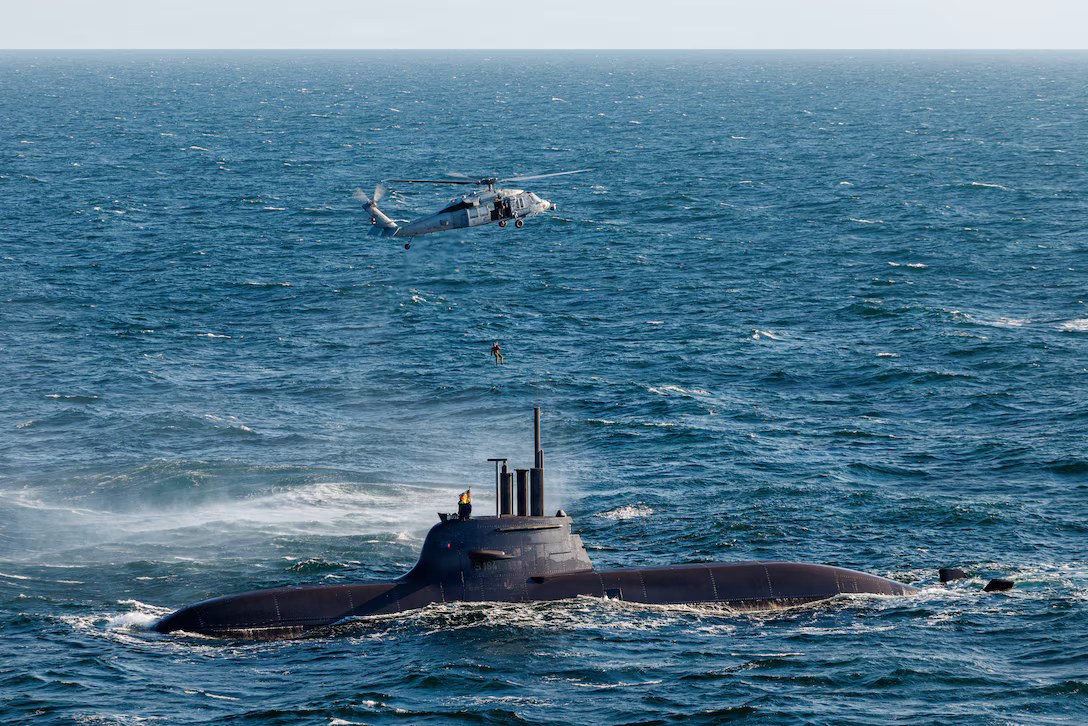
There is a unique beauty in the Arctic; the ice, twisted and contorted by undercurrents and winds, made into irreplicable sculptures. The dark hues of the ocean and the lightness of the sky, tinged with northern lights. There is a beauty in the Arctic, for there is also a danger to it. The fatality of the air, the impossible cold of the churning water, the glacial pace of its movements, and its sudden, cascading collapses. The barren isolation of it. Much the same can be said of the cold steel alloy, which rests beneath the icy surface; which never glimpse the burning colors of the Northern lights. The only life for miles, but conscious life, human life. There is an elegance to the curvature of a glacier, of its shifting colors; such elegance is echoed in the streamlined body of a Borei-Class Russian submarine, powered by a nuclear reactor. Some of the hottest matter on Earth, in one of the coldest regions.
There is a beauty to a submarine, as well, because there is a distinct danger to it.
Nuclear capabilities, covert warfare, sitting above mineral deposits, undersea cables, rest within an arm's reach of such submarines; Russia has roughly 30 such submarines.1 The United States, by contrast, rotates submarine usage in the Arctic, as seen in Operation ICE CAMP Boarfish, wherein a Virginia-class submarine was deployed in the Arctic as recently as March 2026.2 3,4 Despite these US movements, a concerning threat becomes obvious. US Intelligence Community's 2026 Annual Threat Assessment found that Russia concentrates two-thirds of it's sea-based nuclear second-strike capability in Arctic bastions near the Kola Peninsula.5 6 Therein lie seven nuclear-powered ballistic missile submarines (SSBNs) that can reach Barents Sea patrol zones, just northeast of Norway, Finland, and Sweden, in under 24 hours after leaving their stationed bastions.7 8
NATO's response was Operation Arctic Dolphin, an annual Anti-Submarine Warfare (ASW) training exercise that specifically trains for combat in Arctic terrain, while certifying new submariners.9 Additionally, NATO hosts Operation Dynamic Mongoose, a second ASW training program- albeit one not specifically limited to the Arctic.10 11 While Arctic Dolphin takes place off Norway's coasts, particularly in Arctic littoral zones, Dynamic Mongoose occurs directly in the High North; the Norwegian Sea and Arctic Circle itself. Mongoose serves as a strategic exercise to establish a stronger Arctic base for NATO, while Dolphin acts as a certification, practical training and commanding exercise. Put in blunter terms, Arctic Dolphin is the micro training of individuals and their certification; Dynamic Mongoose is the training of the international coalition of NATO nations in coordination and cooperation. Both exercises are in part trained against Russian security threats, as well as to better defend the Greenland, Iceland, UK (and sometimes Norway) Gap (GIUK[-N]).12 13 The GIUK(-N) Gap serves as the Arctic's key chokepoint; given that the Arctic is an increasingly significant region of geopolitics, particularly due to the role of icemelt (the Arctic Circle reached a temperature of 100 F or 37 C this July),14 15 and critical minerals (of which there are 30-50 unique types in the Arctic),16 17 as well as the role of energy resources such as oil and liquified natural gas (LNG) - containing an estimated 22% of the world's untapped supply.18
Therefore, the GIUK(-N) serves as not only a chokepoint between the Arctic and Atlantic, but a chokepoint within the world's most significant chokepoint, the Arctic. A physical chokepoint, as the world is not connected as closely anywhere else; even the Antarctic, which has more landmass than the Arctic19 and therefore cannot run undersea cables, submarines, or ships, is farther from significant land outside of Australia. The Arctic, by contrast, is nearest to Europe, Asia, and North America, wherein the center of the modern world order lies. In terms of technology, the Arctic holds the necessary minerals for advancements; to power that technology, it requires the oil and LNG; to utilize that technology, it has the highest density of satellites above it, of anywhere in the world.20 For trade, military movements, for minerals or energy, the Arctic is a critical chokepoint, most imperatively, because it is not yet claimed or constricted by any one nation. Furthermore, as the ice melts, it becomes more accessible to all nations, and not only the waters, but also the competition becomes increasingly heated in a more resource-scarce world.
The GIUK(-N) serves as the corridor from the Arctic to the Atlantic, serving as the primary point of movement for Russia's Northern Fleet. Naturally, NATO has strategic interest in defending and retaining this Gap, as it did initially in the Cold War, where it served as the line of defense against Russian submarine movements, tracking them utilizing a Sound Surveillance System (SOSUS)21 22 as well as maritime patrol aircraft. The Gap was also utilized to protect allied ships from World War II German U-boats attacking allied trade routes.23
Clearly, the GIUK-(N) holds significance; correspondingly, NATO treats it as such, with such Arctic operations serving to better defend and train for such a specific reason.
Part of the reason the GIUK (-N) is so significant, though, is because it remains ice-free year-round. However, with rising global temperatures, three new chokepoints are slowly thawing into existence. First is the Northern Sea Route (NSR), which acts as Russia's path to the Pacific; increasingly ice-free summers allow this path, which connects the Barents Sea to the Bering Strait,24 from Russia to the United States, with China acting as a support just south of the route. China holds a direct stake in the NSR, as it seeks to utilize it for its Polar Silk Road initiative,25 26 27 to expand trade to Europe, and so benefits from working with Russia to establish and secure such a route. Then there is the North West Passage (NWP), which acts as a bridge between the Atlantic and Pacific oceans, just above Canada. As ice has been reduced over the summers in the NWP, access has been created between the two great oceans, resulting in direct access for Western powers, namely the United States, with interest in both the Atlantic and Pacific regions, to establish faster access from one to the other. This greatly reduces not only time but also dependence on southern routes; nonetheless, it is not as commercially viable as the NSR; and as such serves only as a military corridor,28 and one that is not yet particularly useful so long as much of the ice remains, for most of the year. In such a way it serves as a unique kind of chokepoint- a time-sensitive one, a gate, occasionally swinging open and closed with the seasons, but which, each summer, opens a little longer than the last.
Additionally, there is the Transpolar Sea Route (TSR), a route directly across the Arctic Circle, which dances around the North Pole. It is a deep-water route which has historically been greatly inaccessible due to ice; however, like all other aforementioned routes, ice-free summers, potentially as soon as 2050,29 30 would allow direct passage across the smallest- and therefore fastest- route from Asia to North America to Europe. This is where the thaw would be most prominent; not only because the ice here is the thickest and oldest, but also because the area is entirely unclaimed. Exclusive economic zones (EEZs) for Arctic nations stretch across the Circle and Sea, but do not touch the North Pole.31 32 The center of the world, wherein more nations would be able to stake claim due to their proximity and its centrality, establishes a new ground for competition. The world has never before been connected at a centralized location, wherein East and West are bridged at the top of the globe. As the ice melts, the North Pole- and its route, the TSR- become just that. This route would also allow for a bypass of the GUIK(-N) gap entirely, putting Russia, Scandinavia, and the US and Canada closer than ever. Russia and the United States have long stood eye-to-eye, across the world. However, the thawing of the North shrinks this distance to mere miles.
Lastly, the route of Western Bypass rests, a bridge between Baffin Bay and the Davis Strait. The Western Bypass sits between Canada and Greenland, and historically has already been largely ice-free. However, as the rest of the region becomes more accessible, it becomes more viable. During the Cold War, Soviet attack submarines were able to bypass NATO's GIUK monitoring system by traveling north, over Greenland, and cutting through the Davis Strait into the Atlantic.33 And so the fox found its way into the henhouse, as it were. Nuclear submarines sandwiched between the United States and Europe, ready and able to strike. As the waters around Greenland become more viable, naval planners must treat Greenland as an island that is not only threatened from the East by Russia, but can also be flanked from above on the West,34 35 through the Bypass. NATO would benefit, therefore, from expanding its maritime surveillance beyond the GUIK(-N) boundary line, and instead look up, where Russia has already shown it's able and willing to go.
How, therefore, is the Arctic to be defended- or attacked? What warfare takes place in one of the most hostile environments in the world, where little life exists? The answer lies not on the surfaces of the Arctic, with the ice and bitter wind, but instead beneath it, with Submarines, GIUK(-N) Gap patrols have persistently worked with ASW projects to defend against submarines, and has been explicitly framed by NATO as a vital gateway to the Atlantic. NATO's newly announced Arctic Sentry mirrors the alliance's expansion, seen in the Eastern Sentry and Baltic Sentry establishments elsewhere.36 37 The High North, in short, is formally elevated to the same vigilance category as NATO's eastern flank.38 39
The Kola Bastion for Russian submarines hosts the Northern Fleet at Severomorsk, Gadzhiyevo and Zapadnaya Litsa;40 41,42 the platforms accommodate Delta-IV and Borei SSBNs, which are armed with ballistic missiles of Layner and Bulava class43 44 (submarine-launched ballistic missiles- SLBMs). These establish one arm of a nuclear triad, which is defended by layered air defense, coastal missile systems, aviation, and dense electronic warfare (EW) coverage.45 The role of these tools is to restrict NATO's freedom of access near the patrol areas. This evidence, put in conjunction with the critical chokepoint of the Arctic, displays a clear Russian strategic logic. This is a multi-domain, rich defense system built around a strategic asset; there is a difference between a base which exists to project power, and a base which exists to defend it. Such a fortress around these submarines works not as additional firepower, but as insulation. The logic is as follows: If Russia's SSBNs are pinned in port, located and tracked leaving the base, or destroyed early in the crisis, Moscow's nuclear deterrent is lost. Instead, it becomes hostage to NATO escalation dominance. Nuclear powers work only if the weapons cannot be located and struck. The strategic basing and firepower accompanying the submarines exist to protect the nuclear warheads. Therefore, this bastion and its defense are not any other base in the Arctic, not to Russia; instead, it is an existential, vital piece of power which must remain protected. It is not a power project, then, so much as deterrence for survival.
Naturally, this is where NATO's ASW operations come into play. Arctic Dolphin patrols in the GIUK(-N), and Dynamic Mongoose serve large-scale, international efforts, based in Norway and Iceland, and involve standing NATO Maritime Group One.46 47 The Gap patrols act as a security measure for the Atlantic Ocean, while also enabling Russian Northern Fleet transit. War is not an idle game; Russia does not simply watch NATO's drills in the Arctic in ignorance or apathy; instead, it responds with innovation. Russia's GUGI acts as the main directorate on deep-sea research, and operates the Yantar-class special-purpose survey ship, designed for oceanographic research; nonetheless, Western navies assessed the unit as a seabed-warfare vessel, not a research submarine.48 49 This is largely due to the fact that Yantar is capable of deploying submersibles to 6,000 meters in depth, which is able to reach almost any transatlantic cable, armed with equipment for tapping, mapping, or pre-rigging infrastructure for future disruption.50 51 The warfare of the Arctic rests not only in the waters broken by icebreakers and the satellites mapping the world, but also on the floor of the sea. This potential tampering of cables has the capability to disrupt communication between the United States and its allies, as well as other access to the internet, across the Atlantic as a whole. Open-source tracking has marked Yantar departing Olenya Guba in the Russian Arctic; then appearing off Ireland and Scotland, not far from transatlantic cable routes.52 53 It is the Arctic and its geography which enables Russian interference in Western infrastructure. The naval threats of the Western world come not from the traditional routes of conflict and combat; no longer are there sea-battles and blockcades, but rather new domains, far below the surface and far above the equator. Baltic Sea cable-sabotage has already been conducted to apply pressure on a technological communication chokepoint; the Arctic is merely the expansion of an established principle of strategy.54 55
Arctic Dolphin reflects NATO's deliberate exercising into the seabed-warfare section of strategy and combat, corresponding advancements with the Arctic Sentry's novel role in NATO.56 Yet, such strategy does not come as striking or shocking; the publicity of Arctic Dolphin is not merely a way of projecting power by displaying it internationally, but also works as a normalization of seafloor combat. It seems as routine as any other naval exercise; as does Russian tampering with transatlantic cables.
The status quo has slowly shifted to accept undersea operations as classical warfare tactics, and the abuse of chokepoints, such as cable-tapping, as only an extension of existing strategy. What is changing is where these operations are conducted. The Baltic is no longer the center of pressure by Russian naval power; instead, it is an ever-expanding empire,57 58 claiming mile after mile, as ton after ton of ice dissipates into the salt water.
Ice is elegant, and dangerous. In the same way, Russian submarine systems pose elegant threats, slowly taking the place of the ice in the Arctic. New routes, new resources, and new technologies are becoming available to the world and to the great powers that battle over it; a new theater of war has opened. Potential growth is also potential power; expansion in the Arctic, in any capacity, breeds rivalry, with nations that, with history dating back to the Cold War, hold animosity and distrust. New frontiers, between Greenland and Canada, across the Northern Sea Route, through the Northwest Passage, and of course, resting directly above the North Pole in the Transpolar Sea Route, are emerging. The technology and combat strategy have been studied and ingrained, but merely for one region, directly West of Russia. Russia will not play into Western hands; it is unwise to strike where an opponent is strongest; it is much easier to approach silently, invisibly, from the other direction. Submarines drift just outside Alaska, having taken the NSR;59 or resting between Canada and Greenland in the Western Bypass, or above Canada in the High North, having taken the Transpolar Route. As the ice of the Arctic Ocean thaws, Russia's potential for power expands, while NATO remains focused on a region becoming increasingly obsolete. The GUIK(-N) Gap is critical, no doubt, but its critical nature decreases as these other routes become available. The nature of submarines is to be the stealth force, to tamper with cables and disrupt communications, to drift with nuclear arms just a few hundred miles away from NATO soil, just in case.
Arctic pilots and icebreaker captains have a name for a specific kind of ice; growlers. These growlers rest just below the surface of the ice, small, floating pieces which are hidden to the ships, but are still capable of punching holes in hulls.60 Shoal ice, by contrast, sits on the floor of the ocean, scraping the bottom of ships and sinking them.61
The Arctic is like the ice it holds; it is largely invisible, as is the undersea combat aspect. The world watches for icebreakers, for Coast Guard patrols and planes, all the while there is the subtle amassing of strength underneath the waves, which will act as the major actors of both offense and defense in the battle of the new, thawing front.
1. Nuclear Threat Initiative, "Russia Submarine Capabilities," NTI, August 28, 2024, https://www.nti.org/analysis/articles/russia-submarine-capabilities/. [Note: open-source counts of Russia's current Northern Fleet operational submarine strength vary by outlet and by whether reserve and refit hulls are included; treat thirty as an approximation, corroborate against a current IISS Military Balance entry if precision matters.] ↩
2. U.S. Navy, "Navy Kicks Off Operation Ice Camp 2026 in the Arctic Ocean," navy.mil, March 7, 2026, https://www.navy.mil/Press-Office/News-Stories/display-news/Article/4428238/navy-kicks-off-operation-ice-camp2026- in-the-arctic-ocean/
3. "Navy Kicks Off Operation Ice Camp 2026 in the Arctic Ocean," DVIDS, March 7, 2026, https://www.dvidshub.net/news/559616/navy-kicks-off-operation-ice-camp-2026-arctic-ocean
4. "US Navy Sends Submarines Under Arctic Ice for 100th Time in Milestone Exercise," Military.com, March 11, 2026, https://www.military.com/daily-news/investigations-and-features/2026/03/11/us-navy-sends-submarines-under-arctic-ice -100th-time-milestone-exercise.html. USS Delaware (SSN-791), Virginia-class, and USS Santa Fe (SSN-763) participated; ICE CAMP Boarfish is a biennial Arctic Submarine Laboratory operation rather than a standing rotational deployment. ↩
5. Office of the Director of National Intelligence, Annual Threat Assessment of the U.S. Intelligence Community (Washington, DC: ODNI, March 16, 2026), https://www.intelligence.senate.gov/wp-content/uploads/2026/03/ATA-2026-unclassified-16-Mar-FINAL.pdf
6. "Ukraine War Undermining Russia's Arctic Plans, US Intelligence Says," ArcticToday, March 19, 2026, https://www.arctictoday.com/ukraine-war-undermining-russias-arctic-plans-us-intelligence-says/.
7. Center for Strategic and International Studies, "The Russian Arctic Threat: Consequences of the Ukraine War," CSIS, February 25, 2026, https://www.csis.org/analysis/russian-arctic-threat-consequences-ukraine-war
8. "Russia Deploys Two-Thirds of Its Nuclear Submarine Force in Arctic Forcing US to Rethink Deterrence," Army Recognition, March 19, 2026, https://www.armyrecognition.com/news/navy-news/2026/russia-deploys-two-thirds-of-its-nuclear-submarine-force-in-ar ctic-forcing-us-to-rethink-deterrence. [Note: the seven-SSBN count and twenty-four-hour transit figure trace to open-source synthesis of the 2026 Annual Threat Assessment rather than to the unclassified assessment's own itemized text; corroborate against a primary Navy or ODNI figure before treating as definitive.]
9. Allied Maritime Command, "Exercise Arctic Dolphin 26 Strengthens Allied Anti-Submarine Warfare Training in Norway," NATO MARCOM, February 4, 2026, https://mc.nato.int/media-centre/news/2026/exercise-arctic-dolphin-26-strengthens-allied-antisubmarine-warfare-training -in-norway. ↩
10. Allied Maritime Command, "Allied Forces Unite for High Intensity Anti-Submarine Warfare Training," NATO MARCOM, May 29, 2026, https://mc.nato.int/media-centre/news/2026/allied-forces-unite-for-high-intensity-antisubmarine-warfare-training
11. Allied Maritime Command, "Silent Hunters: NATO Trains for Undersea Warfare in the High North," NATO MARCOM, May 18, 2026, https://mc.nato.int/media-centre/news/2026/silent-hunters-nato-trains-for-undersea-warfare-in-the-high-north. Dynamic Mongoose runs annually in the Norwegian Sea and, unlike Arctic Dolphin, is not confined to Norwegian littoral waters.
12. "The GIUK Gap – The Chokepoint in Britain's Backyard," UK Defence Journal, January 21, 2023, https://ukdefencejournal.org.uk/the-giuk-gap-the-chokepoint-in-britains-backyard/
13. "Geopolitics of the GIUK Gap: Past, Present, and Future," Geopolitical Monitor, February 12, 2026, https://www.geopoliticalmonitor.com/geopolitics-of-the-giuk-gap-past-present-and-future/.
14. World Meteorological Organization record cited in "Newly-Confirmed Arctic Record 100-Degree Heat in Siberia Setting Off Climate Change 'Alarm Bells,' U.N. Says," CBS News, https://www.cbsnews.com/amp/news/arctic-record-siberia-100-degree-heat-climate-change-alarm-bells-un
15. Rick Thoman, "Arctic July 2026 Climate Summary," Alaska Climate, August 2026, https://alaskaclimate.substack.com/p/arctic-july-2026-climate-summary. [Note: the WMO-verified 100.4°F (38°C) Arctic Circle record was set at Verkhoyansk on June 20, 2020, not this July. Thoman's July 2026 summary confirms a very warm month (up to 100°F/37.7°C at Namsty, July 9–10) but this is not a new all-time record; this should not read as a new July 2026 record.]
16. Oxford Institute for Energy Studies, "Critical Minerals in the Arctic," SP36, 2025, https://www.oxfordenergy.org/wpcms/wp-content/uploads/2025/02/SP36-Critical-Minerals-in-the-Arctic.pdf ↩
17. Wilson Center, "Critical Minerals in the Arctic: Forging the Path Forward," https://www.wilsoncenter.org/sites/default/files/media/uploads/documents/Critical%20Minerals%20in%20the%20Arctic %20-%20Forging%20the%20Path%20Forward.pdf. [Note: neither source gives a single authoritative count of "30–50" mineral types; recommend sourcing this figure to a specific inventory, e.g. the USGS critical minerals list, rather than a round range.] ↩
18. Kenneth J. Bird et al., "Circum-Arctic Resource Appraisal: Estimates of Undiscovered Oil and Gas North of the Arctic Circle," U.S. Geological Survey Fact Sheet 2008-3049, July 24, 2008, https://www.usgs.gov/publications/circum-arctic-resource-appraisal-estimates-undiscovered-oil-and-gas-north-arctic. The 22 percent figure covers combined undiscovered oil, gas, and natural gas liquids (13 percent of oil, 30 percent of gas, 20 percent of NGLs specifically); this remains the 2008 USGS estimate and has not been formally updated. ↩
19. National Snow and Ice Data Center, "Sea Ice," NSIDC, https://nsidc.org/learn/parts-cryosphere/sea-ice. Antarctica is a continuous, ice-covered landmass of roughly 14.2 million square kilometers, while the Arctic is a semi-enclosed ocean basin of comparable area but with only fringing permanent land. ↩
20. [Note: I could not locate a credible source substantiating that the Arctic has "the highest density of satellites above it, of anywhere in the world." Polar-orbiting satellites do converge over the poles by orbital geometry, but this is a distinct claim from satellite density, and satellite operators generally report the highest satellite (and especially geostationary) density over the equatorial belt and populated mid-latitudes, not the poles. Recommend either sourcing this claim precisely or revising it to reference polar-orbit convergence specifically.] ↩
21. [Author], "Fixed Sonar Systems," The Submarine Review, April 2011, https://nps.edu/documents/103449515/0/HOWARDAPR2011.pdf/1219db41-a727-4940-ab0b-b953c54f6e01
22. "(Un)Mind the Gap," U.S. Naval Institute Proceedings 145, no. 10 (October 2019), https://www.usni.org/magazines/proceedings/2019/october/unmind-gap.
23. "Geopolitics of the GIUK Gap: Past, Present, and Future," Geopolitical Monitor, February 12, 2026, https://www.geopoliticalmonitor.com/geopolitics-of-the-giuk-gap-past-present-and-future/. ↩
24. The Arctic Institute, "The Future of the Northern Sea Route – A 'Golden Waterway' or a Niche Trade Route," The Arctic Institute, https://www.thearcticinstitute.org/future-northern-sea-route-golden-waterway-niche/. ↩
25. China Media Project, "Polar Silk Road," January 19, 2026, https://chinamediaproject.org/the_ccp_dictionary/polar-silk-road/ ↩
26. Center for Strategic and International Studies, "China Launches the Polar Silk Road," October 13, 2024, https://www.csis.org/analysis/china-launches-polar-silk-road ↩
27. Kong Soon Lim, "China's Arctic Policy and the Polar Silk Road Vision," Arctic Yearbook 2018, https://arcticyearbook.com/images/yearbook/2018/Scholarly_Papers/24_AY2018_Kong.pdf. ↩
28. Y. Min et al., "Projections of Arctic Sea Ice Conditions and Shipping Routes in the Twenty-First Century Using CMIP6 Forcing Scenarios," Environmental Research Letters, October 7, 2020, https://iopscience.iop.org/article/10.1088/1748-9326/abb2c8. [Corrected figure: under the high-emissions SSP5-8.5 scenario, this study projects the probability of a September transit via the Northwest Passage's northern route rising from about 19.6 percent in the early twenty-first century (2021–2035) to about 76.7 percent by the late twenty-first century (2086–2100), not a flat 82 percent at mid-century; the passage remains seasonal and probabilistic rather than reliably open even in the higher-emissions case.] ↩
29. The Arctic Institute, "The Future of Arctic Shipping along the Transpolar Sea Route," The Arctic Institute, https://www.thearcticinstitute.org/future-arctic-shipping-transpolar-sea-route/ ↩
30. Malte Humpert et al., "The Opening of the Transpolar Sea Route: Logistical, Geopolitical, Environmental, and Socioeconomic Impacts," Marine Policy, 2020, https://www.sciencedirect.com/science/article/abs/pii/S0308597X2030453X. Peer-reviewed modeling places a seasonally ice-free Central Arctic Ocean at the 2040s–2050s depending on emissions scenario. ↩
31. Peace Palace Library, "Arctic Sovereignty: Icy Roads to the North Pole," https://peacepalacelibrary.nl/blog/2014/arctic-sovereignty-icy-roads-north-pole ↩
32. "Chapter 8: The Arctic & the LOSC," Law of the Sea (Tufts University), https://sites.tufts.edu/lawofthesea/chapter-eight/. Standard EEZs under UNCLOS extend 200 nautical miles from a coastal baseline; the North Pole lies well beyond that limit from every Arctic coastal state. ↩
33. "Soviet Strategic Interest in the Maritime Arctic," U.S. Naval Institute Proceedings 99, no. 5 (May 1973), https://www.usni.org/magazines/proceedings/1973/may/soviet-strategic-interest-maritime-arctic. [Note: this source establishes Davis Strait as one of three recognized Arctic Ocean "gates" within Cold War chokepoint strategy, but does not itself document a specific historical instance of Soviet submarines transiting north of Greenland through Davis Strait; recommend verifying this claim independently before publication.] ↩
34. "Greenland Is Strategic. Annexation Is Not," War on the Rocks, February 3, 2026, https://warontherocks.com/2026/01/greenland-is-strategic-annexation-is-not/.
35. "Military Threats In, To, and Through the Arctic East of Greenland," North American and Arctic Defence and Security Network (NAADSN), https://www.naadsn.ca/wp-content/uploads/2023/09/East-of-Greenland-report-RD.pdf. [Note: open literature on a symmetrical northern/western threat axis through the Western Bypass specifically is thinner than for the eastern axis, so this remains this paper's own extension of the East-of-Greenland framework rather than a directly sourced claim.]
36. USNI News, "NATO Launches Arctic Sentry in High North in Response to Russian Activity," February 16, 2026, https://news.usni.org/2026/02/16/nato-launches-arctic-sentry-in-high-north-in-response-to-russian-activity
37. Allied Air Command, "NATO Announces Arctic Sentry – Enhancing NATO's Presence in the Arctic and the High North," February 13, 2026, https://ac.nato.int/archive/2026/nato-announces-arctic-sentry-enhancing-natos-presence-in-the-arctic-and-the-high-north. Baltic Sentry launched January 14, 2025, and Eastern Sentry launched September 12, 2025; Arctic Sentry followed on February 11, 2026, led by Joint Force Command Norfolk.
38. "NATO's Sentry Triad: The Standing Operation Replaces the Exercise," June 4, 2026, https://www.grosswald.org/nato-sentry-triad-standing-operation-replaces-exercise/
39. Center for European Policy Analysis, "NATO Awakens in the High North," March 19, 2026, https://cepa.org/article/nato-awakens-in-the-high-north/.
40. Center for Strategic and International Studies, "The Ice Curtain: Modernization on the Kola Peninsula," April 23, 2026, https://www.csis.org/analysis/ice-curtain-modernization-kola-peninsula
41. "The Ice Curtain: Kola Peninsula Part 2: Expanded Maritime Facilities," tearline.mil, https://www.tearline.mil/public_page/the-ice-curtain-kola-peninsula-part-2-expanded-maritime-facilities/
42. "Zapadnaya Litsa (naval base)," Wikipedia, https://en.wikipedia.org/wiki/Zapadnaya_Litsa_(naval_base). [Note: Delta-IV and Borei SSBNs are based specifically at Gadzhiyevo (Yagelnaya Bay), not at Zapadnaya Litsa, which instead hosts Yasen-class attack submarines and GUGI's special-purpose deep-diving fleet; Severomorsk is primarily the Northern Fleet's surface headquarters. This should be corrected to name Gadzhiyevo as the SSBN base before publication.] ↩
43. "Russia Deploys Two-Thirds of Its Nuclear Submarine Force in Arctic Forcing US to Rethink Deterrence," Army Recognition, March 19, 2026, https://www.armyrecognition.com/news/navy-news/2026/russia-deploys-two-thirds-of-its-nuclear-submarine-force-in-ar ctic-forcing-us-to-rethink-deterrence
44. Jamestown Foundation, "Russia Prepares to Add Newest Nuclear-Powered Submarine to the Northern Fleet," Jamestown Foundation Eurasia Daily Monitor, published circa late May 2025, https://jamestown.org/russia-prepares-to-add-newest-nuclear-powered-submarine-to-the-northern-fleet/. [Note: verify the exact publication date directly from the Jamestown page before citing in final form; the article describes the Knyaz Pozharsky joining the Northern Fleet in June 2025 as upcoming, suggesting a May 2025 publication date rather than 2026.]
45. Royal Navy, "North Atlantic Anti-Submarine Defences Bolstered after NATO Workout," June 11, 2026, https://www.royalnavy.mod.uk/news/2026/june/11/20260611-north-atlantic-anti-submarine-defences-bolstered-after-nato -workout. ↩
46. Allied Maritime Command, "Allied Forces Unite for High Intensity Anti-Submarine Warfare Training," NATO MARCOM, May 29, 2026, https://mc.nato.int/media-centre/news/2026/allied-forces-unite-for-high-intensity-antisubmarine-warfare-training
47. Allied Maritime Command, "Exercise Arctic Dolphin 26 Strengthens Allied Anti-Submarine Warfare Training in Norway," NATO MARCOM, February 4, 2026, https://mc.nato.int/media-centre/news/2026/exercise-arctic-dolphin-26-strengthens-allied-antisubmarine-warfare-training -in-norway.
48. Royal United Services Institute, "Stalking the Seabed: How Russia Targets Critical Undersea Infrastructure," https://www.rusi.org/explore-our-research/publications/commentary/stalking-seabed-how-russia-targets-critical-undersea -infrastructure
49. Center for Maritime Strategy, "The Enemy Below: Fighting against Russia's Hybrid Underwater Warfare," June 23, 2023, https://centerformaritimestrategy.org/publications/the-enemy-below-fighting-against-russias-hybrid-underwater-warfare/
50. Center for Maritime Strategy, "The Enemy Below: Fighting against Russia's Hybrid Underwater Warfare," June 23, 2023, https://centerformaritimestrategy.org/publications/the-enemy-below-fighting-against-russias-hybrid-underwater-warfare/
51. "UK Tracks Russian Spy Vessel Yantar Near Scotland as It Answers with Laser Harassment," Army Recognition, 2025, https://www.armyrecognition.com/news/navy-news/2025/uk-tracks-russian-spy-vessel-yantar-near-scotland-as-it-answer s-with-laser-harassment.
52. H I Sutton, "Russian Spy Ship Yantar Loitering Near Trans-Atlantic Internet Cables," Naval News, August 19, 2021, https://www.navalnews.com/naval-news/2021/08/russian-spy-ship-yantar-loitering-near-trans-atlantic-internet-cables/
53. "'Yantar': Russian Reconnaissance Ship Causes Unrest," marineforum, April 22, 2026, https://marineforum.online/en/russian-yantar-attracts-attention/. GUGI's Kola Peninsula home base is Olenya Bay (Olenya Guba); Yantar has been tracked off Ireland and, separately, off Scotland.
54. Carnegie Endowment for International Peace, "The Baltic Sea at a Boil: Connecting the Shadow Fleet and Episodes of Subsea Infrastructure Sabotage," December 4, 2025, https://carnegieendowment.org/research/2025/06/baltic-russia-maritime-cable-sabotage
55. European Council on Foreign Relations, "Shallow Seas and 'Shadow Fleets': Europe's Undersea Infrastructure Is Dangerously Vulnerable," July 9, 2025, https://ecfr.eu/article/shallow-seas-and-shadow-fleets-europes-undersea-infrastructure-is-dangerously-vulnerable/.
56. USNI News, "NATO Launches Arctic Sentry in High North in Response to Russian Activity," February 16, 2026, https://news.usni.org/2026/02/16/nato-launches-arctic-sentry-in-high-north-in-response-to-russian-activity. ↩
57. NPR, "What to Know about Finland, Russia's 'Shadow Fleet' and a Severed Undersea Cable," December 31, 2024, https://www.npr.org/2024/12/31/nx-s1-5243302/finland-russia-severed-undersea-cable-shadow-fleet.
58. ACLED, "Russia's Shadow Fleet Presents a Sustained Hybrid War Threat at Sea," May 22, 2026, https://acleddata.com/report/russias-shadow-fleet-presents-sustained-hybrid-war-threat-sea.
59. "Coast Guard Meets Russian Naval Vessels in US Waters off Alaska Coast," Stars and Stripes, September 17, 2024, https://www.stripes.com/theaters/asia_pacific/2024-09-17/us-alaska-russian-navy-15204057.html. U.S. Coast Guard officials confirmed a Russian surface action group including two submarines transited roughly 30 miles into U.S. waters near Point Hope, Alaska, in September 2024; this documents recent Russian submarine presence off Alaska but does not itself confirm the Northern Sea Route specifically, as opposed to the Bering Strait more generally, as the route taken. ↩
60. National Snow and Ice Data Center, "Growler," NSIDC Cryosphere Glossary, https://nsidc.org/learn/cryosphere-glossary/growler; National Oceanic and Atmospheric Administration, "JetStream Max: Icebergs," NOAA, https://www.noaa.gov/jetstream/icebergs-max. ↩
61. Canadian Coast Guard, "Annex I: Terminology for Ice, Navigation and Vessel Design," Canada.ca, https://www.canada.ca/en/canadian-coast-guard/corporate/publications/ice-navigation-in-canadian-waters/annex-termino logy-for-ice-navigation-vessel-design.html. ↩
Prefer the original layout? Open this essay in the PDF issue (p. 33) →